How to eat a steak: carving, salt and sauces
Why you carve against the grain, when to add salt, why resting matters, which knife to use and why sauces belong on the side, not on top.
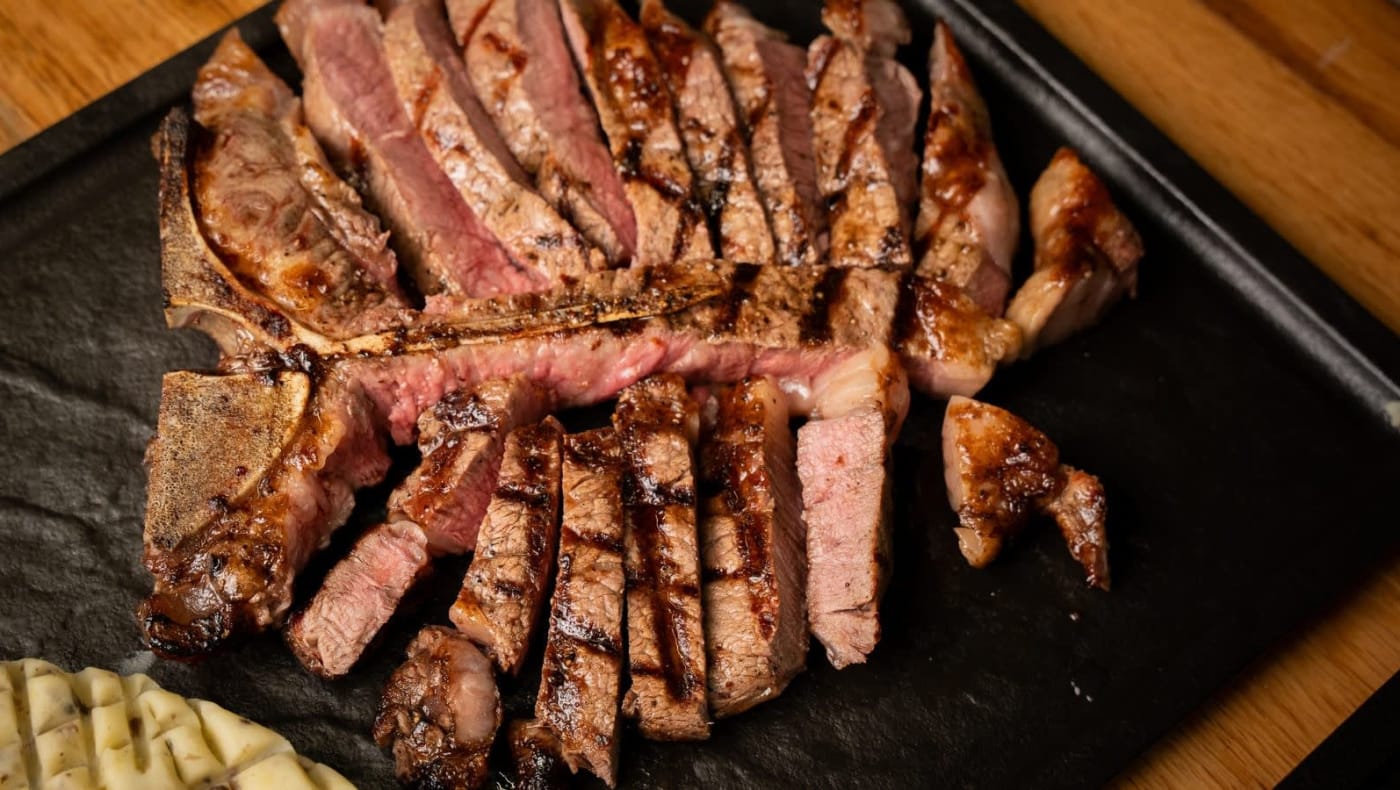
Carve against the grain
This is the one thing on the list that transforms the result. Look at the cut and find the parallel lines running through it — these are the bundles of muscle fibre.
If you cut along them, every piece on your plate holds long, intact fibres that your teeth have to tear apart. If you cut across them, the knife does that work for you and the fibres reach your mouth short.
The same piece of meat can seem tough or tender depending on the direction you cut it. On T-bone cuts, the grain changes direction on either side of the bone — and so must your knife.
Don't cut it all at once
The habit of slicing the whole piece before you start eating comes from the way children are fed. The trouble is that every cut lets juice escape, and the exposed surface cools quickly.
Cut one piece, eat it, cut the next. The last mouthful will be as hot and juicy as the first.
Let it rest
If it reaches the table straight off the grill, wait two or three minutes. The contracted fibres relax and reabsorb the juices.
Juice on the plate is juice no longer in the meat. It is not a good sign, whatever many believe.
Salt goes on last
The meat leaves the kitchen already seasoned, before and during cooking. If you want more, use coarse salt, on the piece you have just cut, not over the whole surface.
A large crystal does not dissolve at once; it gives a small burst of salt, followed by the flavour of the meat. Fine salt, sprinkled at the start, merely seasons evenly and masks.
Sauces on the side
A sauce poured over the whole piece covers the browned crust, the part the chef has worked hardest on. Better to keep it to one side of the plate and dip each piece as you please.
The rule of thumb: the fattier the meat, the less sauce it needs. A dry-aged ribeye needs nothing. A tenderloin, being lean, benefits from a green peppercorn or gorgonzola sauce.
The knife matters
A sharp, straight-edged knife slices through the fibre. A serrated one tears it. You can see the difference on the cut surface: smooth in the first case, ragged in the second.
If you have to press hard, something is wrong — either the knife or the direction of the cut.
Fat is not waste
The band of fat along the edge of a striploin and the eye at the centre of a ribeye are exactly where the flavour lies. Properly rendered, they are the best mouthfuls on the plate.
Trim them off and leave them on the side, and you have paid for them only to throw them away.
A few minutes' patience when ordering
A thick cut, such as a one-kilo Tomahawk, needs real time on the grill plus resting. If it arrives in ten minutes, it has been rushed.
Order your starters with that in mind and let the kitchen do its work.