A map of beef: where every cut comes from
Ribeye, T-Bone, Tomahawk, fillet, sirloin. Where each sits on the animal, how hard the muscle works and what that means for tenderness, fat and price.
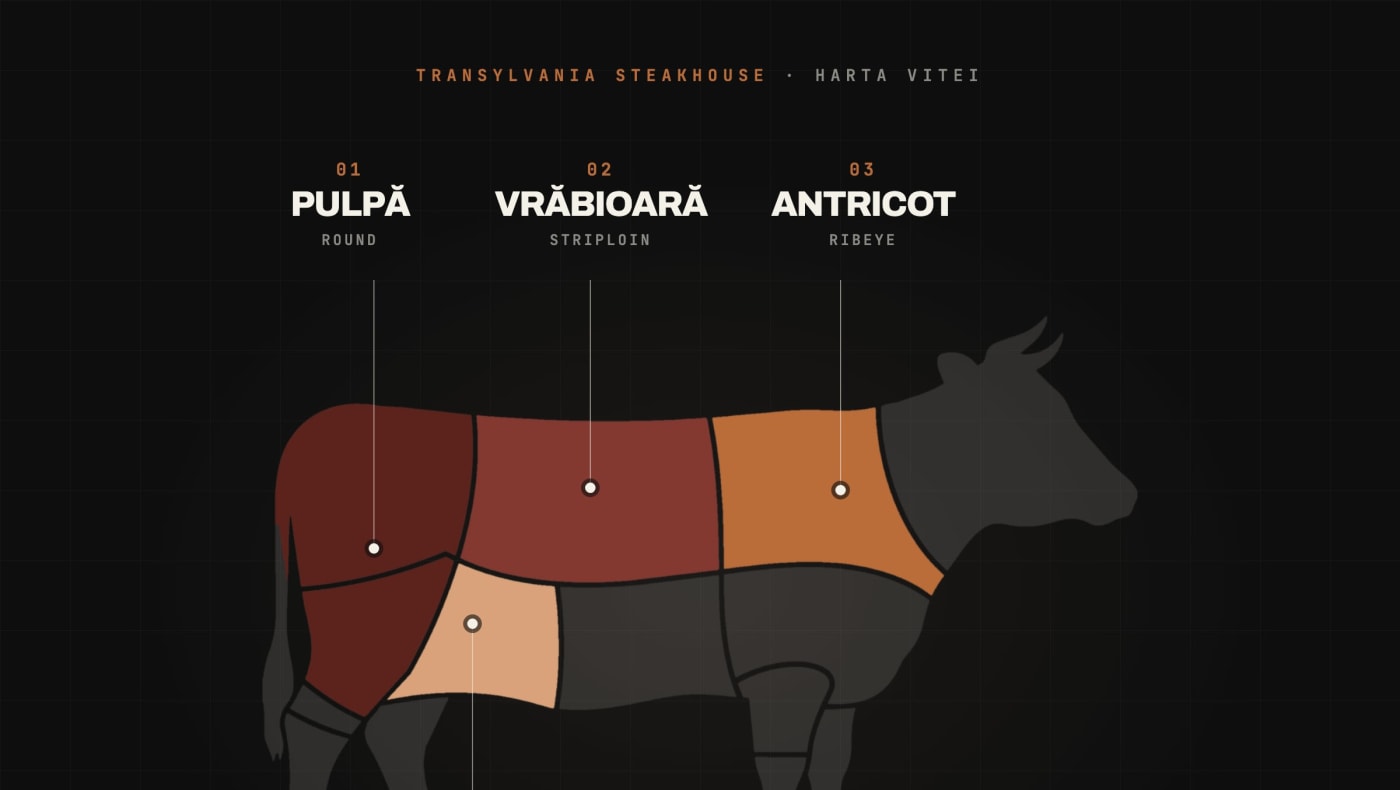
One rule explains almost everything: the harder a muscle works, the tougher and more flavourful it is. The less it works, the more tender and milder it is.
Cattle stand on their legs and hold their heads up their whole lives. So the muscles at the extremities — neck, shoulders, hind leg — work constantly. Those in the middle of the back, protected by the spine, barely work at all. That is where the entire price hierarchy comes from.
The rib: along the ribcage
This is the section between the 6th and 12th ribs, along the back. The muscle there bears weight but moves little. It has abundant intramuscular fat — the white threads you see in cross-section, which we call marbling.
That fat melts with heat and bastes the meat from within. This is why the rib stays juicy even if you take it slightly past medium rare, unlike the fillet, which dries out at once.
- Ribeye The boneless rib. At its centre is the ‘eye’ — a ring of fat surrounded by muscle. The most balanced cut on the animal.
- Bone-in ribeye The same muscle, with the rib bone left on. The bone slows cooking on its side and adds flavour.
- Tomahawk A ribeye with the bone left long and scraped clean, like a handle. The same meat, a different presentation. From 600 g to 1.3 kg.
The sirloin: the upper back
It continues from the rib towards the tail. The muscle works a little harder, so the grain is denser and the marbling more restrained. In return, it has a thick band of fat along one edge, which renders on the grill and bastes the whole cut.
It is known as New York Strip. It has a more pronounced beef flavour than ribeye and a firmer texture, which suits those who find the rib too rich.
The fillet: beneath the spine
A slender strip that runs under the backbone, fully protected. It supports nothing and practically never moves. It is the most tender muscle on the animal — and the leanest.
Precisely because it has little fat, it has little flavour of its own. That is why it is almost always served with a sauce: green peppercorn, gorgonzola, truffle. And why it is cooked briefly, to a lower temperature. Past medium, it turns dry and mealy.
- Filet mignon Cut from the narrow end of the fillet.
- Chateaubriand The thick centre piece, shared between two.
- Tartare The fillet is the only cut that can be eaten raw, chopped by hand with a knife.
T-bone cuts
This is where it all connects. In the loin, the spine separates the sirloin from the fillet. Cut straight through the spine and you get a piece that contains both muscles, separated by a T-shaped bone.
The difference between a T-Bone and a Fiorentina lies in how much fillet remains attached. The Fiorentina is cut further back, where the fillet is thicker, and is a larger piece. The T-Bone is cut further forward, where the fillet is only just beginning.
These are difficult cuts to cook well, because the two muscles call for different temperatures. A good cook places the steak on the grill with the fillet side furthest from the heat.
The rump: the hind leg
Hard-working muscle, long-grained and lean. It is not suited to quick grilling — it would turn out tough. It is excellent, however, slow-cooked, salt-cured or sliced very thin.
This is where our bresaola comes from, cured for 60 days, and where the Picanha is cut: a piece with a thick fat cap on top, much prized in Brazil.
What to order, depending on what you are after
- Most tender Fillet, filet mignon. Order it with a sauce.
- Most flavourful Ribeye or Tomahawk. The marbling does the work.
- Balance New York Strip. Firm grain, clear flavour, less fat.
- For two Fiorentina or Chateaubriand.
- First time at a steakhouse Ribeye, medium rare. It is the most forgiving cut.